Noor Ouarzazate Solar Plant: What It Is and Whether You Can Visit
Ten kilometres from town, more than 3,000 hectares of mirrors and a tower about 250 metres tall power a large part of southern Morocco. What Noor is, how it works and what a visitor can actually see.
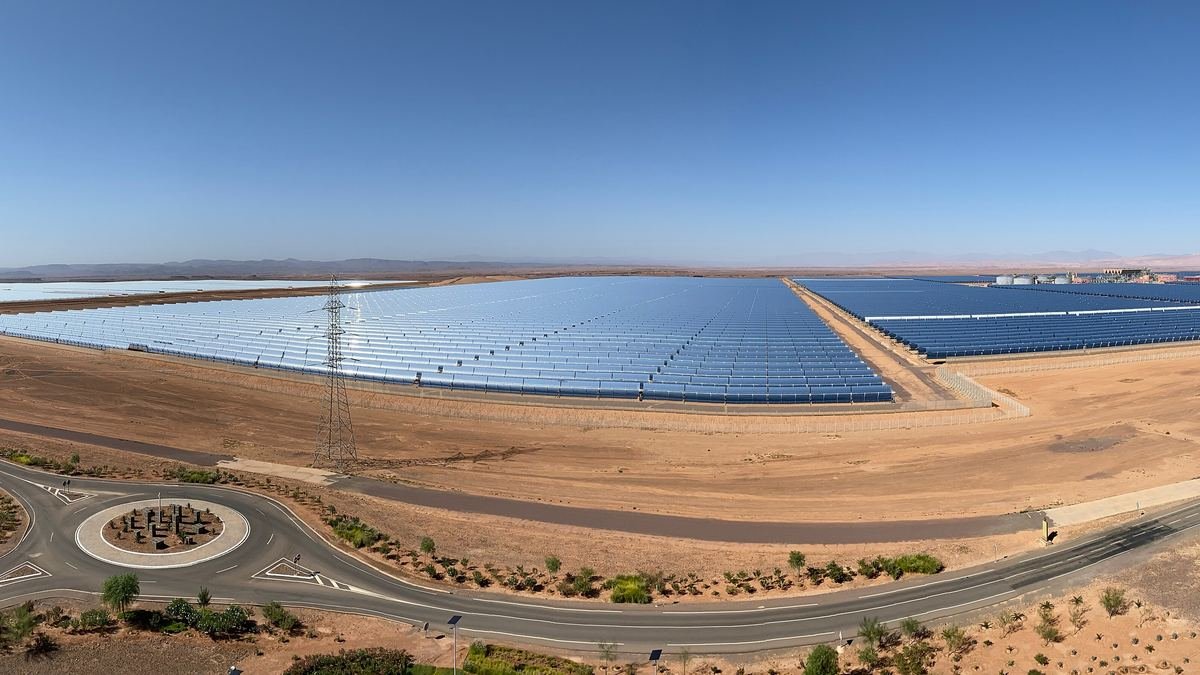
The Noor Ouarzazate solar plant is a complex of four solar power stations about 10 km north-east of Ouarzazate, with a combined capacity of about 580 megawatts. When its last units came online in 2018, it was the largest concentrated solar power complex in the world. You cannot simply drive in and look around: visits are possible only on request to MASEN, the Moroccan agency that runs it. This guide explains what Noor is, how it works and what you can realistically see as a visitor.
What Noor Ouarzazate is
Noor ("light" in Arabic) is the flagship of Morocco's solar programme, led by MASEN, the Moroccan Agency for Sustainable Energy. The Ouarzazate complex spreads over more than 3,000 hectares of stony plateau in the rural commune of Ghessate, on the high desert between the town and the foothills of the Atlas.
It was built in stages between 2013 and 2018 by a consortium led by the Saudi developer ACWA Power, with loans from the World Bank, the African Development Bank, the European Investment Bank, Germany's KfW, the French AFD and the European Union. The aim was to cut Morocco's reliance on imported fossil fuels, and the country has set a target of more than half of its electricity capacity from renewables by 2030.
Ouarzazate was chosen for the same reason film crews come here: intense sunshine on most days of the year, plus available land and water from the El Mansour Eddahbi reservoir nearby.
Noor I, II, III and IV in figures
The complex combines three technologies, which is part of what makes it interesting.
| Plant | Capacity | Technology | Heat storage | In service |
|---|---|---|---|---|
| Noor I | 160 MW | Parabolic trough mirrors | About 3 hours | 2016 |
| Noor II | 200 MW | Parabolic trough mirrors, dry cooling | About 7 hours | 2018 |
| Noor III | 150 MW | Solar tower, dry cooling | About 7 hours | 2018 |
| Noor IV | 72 MW | Photovoltaic panels with trackers | None | 2018 |
Noor I was inaugurated by King Mohammed VI in February 2016. Noor II, Noor III and the photovoltaic plant Noor IV followed during 2018, bringing the total to about 580 MW.
How concentrated solar power works
Most solar parks you see on roofs and fields are photovoltaic: panels turn light directly into electricity. Noor I, II and III work differently. They use mirrors to concentrate sunlight into heat, then use that heat to make steam and drive a turbine, like a conventional power station without the fuel.
Parabolic troughs (Noor I and II)
Long curved mirrors follow the sun from east to west and focus its rays onto a tube running along their centre. A fluid inside the tube heats up and carries the heat to the power block. These are the endless silver rows you see from the air or in the cover photo.
The solar tower (Noor III)
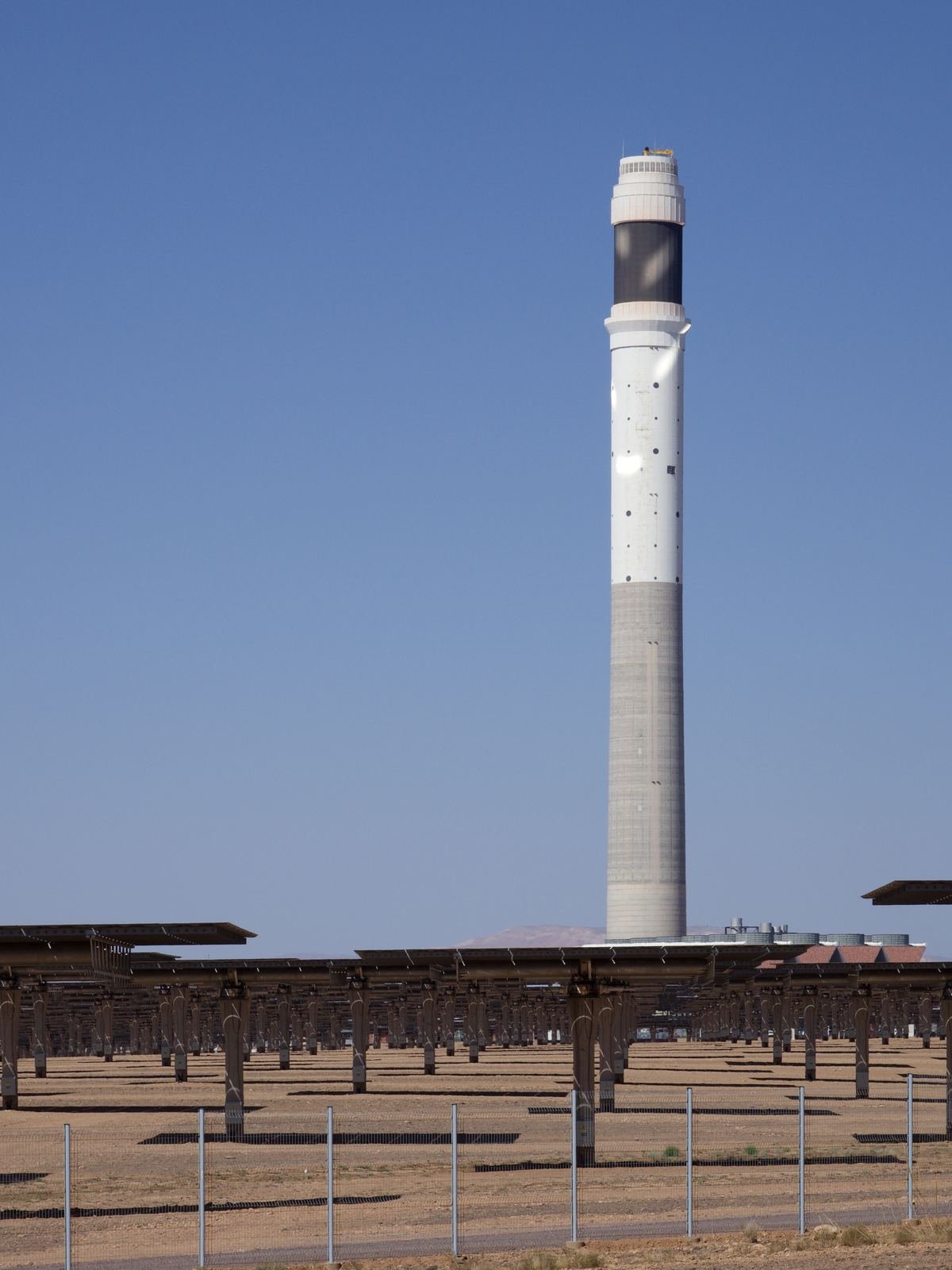
Thousands of flat mirrors, called heliostats, track the sun and reflect it onto a receiver at the top of a tower about 250 metres tall. Molten salt flows through the receiver and is heated directly. When the plant is running, the top of the tower glows brightly, and it can be seen from far across the plain.
Storing the sun
The key advantage of the CSP plants is storage. Part of the heat is kept in large tanks of molten salt and used after sunset, so Noor can keep supplying electricity into the evening, when demand peaks. Noor II and III also use dry cooling, which needs far less water than the usual cooling towers, an important point in a region where water is scarce.
Is it still the largest?
Noor Ouarzazate is often described as the largest concentrated solar power plant in the world. That was true when it was completed. Since 2023, the 700 MW concentrated solar plant in Dubai's Mohammed bin Rashid Al Maktoum Solar Park has been larger. And if you count photovoltaic parks too, several in China, India and the Gulf have far higher capacities. Noor remains one of the largest CSP complexes anywhere.
It has also had technical problems worth knowing about. Noor III, the tower plant, was offline for long periods after leaks in its hot molten salt tank, first from 2021 and again from February 2024, before restarting in April 2025 after a repair lasting about 14 months. Further problems were reported later in 2025. The trough and photovoltaic plants were not affected by these outages.
Can you visit the Noor Ouarzazate solar plant?
Honestly, for most travellers the answer is no, or not easily. Noor is a secured industrial site, not a visitor attraction. There is no ticket office, no visitor centre open to the public and no walk-in tour.
MASEN does accept visit requests, mostly from schools, universities, professionals and organised groups. According to MASEN's site visit page (checked in October 2026):
- requests must be sent one month before the desired date;
- visits take place Monday to Friday, between 9:30 and 18:00;
- groups are limited to 40 people;
- visitors stay in designated "green zones" that do not require safety equipment;
- shorts, dresses, skirts, heels and open sandals are not allowed, and long sleeves are recommended;
- photos and videos are allowed, and MASEN can cancel a visit if it would disrupt operations.
When we last checked, the online request form on that page was disabled, so you would need to contact MASEN directly. Plan well ahead, explain who you are and why you want to visit, and do not build a trip around it unless you have a written confirmation.
Seeing Noor from the road
Without an approved visit, the realistic option is to see the plant from the outside. The complex lies about 6 km north of the N10, the road that leads east from Ouarzazate towards Skoura, the Dades valley and Errachidia. On a clear day the Noor III tower stands out above the plain, and from higher ground you can make out the shining fields of mirrors.
- On the way to Skoura or the Dades: if you are driving east to Skoura and Kasbah Amridil or the Dades Gorges, look north in the first part of the drive.
- Respect the perimeter: do not drive up to the gates expecting to get in, and do not fly a drone near the site.
The light is best early in the morning or late in the afternoon, when the mirrors flash and the Atlas behind turns pink. Our guide to the best time to visit Ouarzazate explains the seasons.
Practical notes
The complex is about 10 km from central Ouarzazate by paved roads. There are no services at the site itself, so treat it as a short stop on a longer day rather than an outing on its own. A rental car or a driver hired for the day makes it easy to combine with the palm grove of Skoura; see our guide to car hire in Ouarzazate.
If you are a student, engineer or group leader planning an official visit, staying in town for a few nights gives you flexibility if MASEN offers a different date. Residence Chay is about 3 minutes from the centre, and our location page shows how it sits in relation to the main roads out of town. For everything else the town offers, see our list of things to do in Ouarzazate.
Questions travellers ask
Can tourists visit the Noor Ouarzazate solar plant?
Only through an organised visit approved in advance by MASEN, the agency that runs the complex. There is no ticket office and no walk-in visit. Without an approval, you can only see the plant from the surrounding roads.
Is Noor Ouarzazate the largest solar plant in the world?
It was the world's largest concentrated solar power complex when it was completed in 2018. Dubai's 700 MW concentrated solar plant, completed in 2023, is now larger, and many photovoltaic parks elsewhere are far bigger in capacity.
How far is the Noor solar plant from Ouarzazate?
About 10 km north-east of the town, reached from the N10, the road towards Skoura and Errachidia.
Does Noor produce electricity at night?
Yes, partly. Noor I, II and III store heat in tanks of molten salt and can keep generating for several hours after sunset. Noor IV, the photovoltaic plant, only produces in daylight.