Telouet Kasbah and the Ounila Valley Road from Ouarzazate
The former seat of the Glaoui lords sits at about 1,800 m in the High Atlas, roughly 75 km from Ouarzazate by the Ounila valley. What you can see today, how the road is, and how to turn it into a full-day loop.
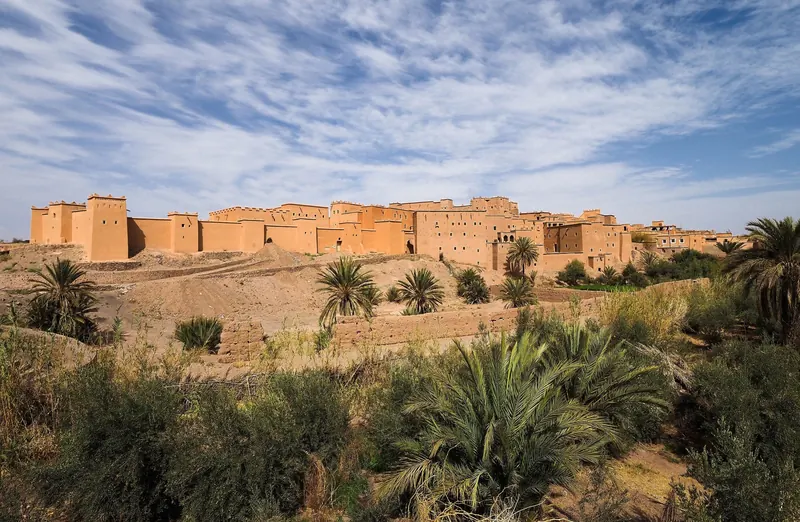
Telouet kasbah is the ruined palace of the Glaoui family, the clan that controlled the High Atlas passes and much of southern Morocco until 1956. It stands at about 1,800 m in a wide mountain basin, roughly 75 km from Ouarzazate by the Ounila valley road, a drive of about 2 hours each way. Most of the building is crumbling earth, but a suite of reception rooms with tiles, carved plaster and painted cedar ceilings survives, and after a closure that followed the 2023 earthquake, part of it can be visited again.
This guide covers what you can see today, the history behind it, the Ounila valley road through Tamdaght and Anemiter, and the ways to turn the trip into a day loop from Ouarzazate.
Telouet at a glance
| Item | What to expect |
|---|---|
| Distance from Ouarzazate via the Ounila valley | about 75 km, around 2 hours without stops |
| Distance from Ouarzazate via the N9 and Tizi n'Tichka side road | about 110 km, around 2 hours |
| Aït Ben Haddou to Telouet | about 45 km on the P1506 |
| Telouet to the N9 | about 20 km, joining the main road a few kilometres south of the Tizi n'Tichka pass |
| Altitude | about 1,800 m (the Tizi n'Tichka pass is signposted at 2,260 m) |
| Road surface | paved all the way on both routes, suitable for an ordinary car |
| Time on site | about 1 to 2 hours for the kasbah, more if you walk around the village |
| Status | partly open after earthquake repairs; open areas can change |
The Glaoui family and the history of Telouet
Telouet sits on the old caravan route that crossed the High Atlas between Marrakech and the Saharan oases, close to salt deposits that were valuable trade goods. Whoever held the village could tax the traffic over the mountains. In the 19th century that was the Glaoui, a Berber family whose chiefs built their fortune on the passes, on salt and on the trade in goods coming up from the south.
From mountain chiefs to lords of the south
Work on the kasbah began around 1860 under the family chief of the time, and it kept growing for decades as the clan became richer. The turning point came in 1893, when Sultan Hassan I's army was caught by winter weather in the Atlas on its way back from an expedition. Madani El Glaoui sheltered and supplied the royal column, and in return received modern weapons and official authority over the region. From then on the Glaoui expanded their control along the routes to Ouarzazate, where they also enlarged Kasbah Taourirt, and towards the Draa and the Dades.
Thami El Glaoui, Pasha of Marrakech
After Madani died in 1918, his brother Thami El Glaoui became head of the family. He had been named Pasha of Marrakech in 1912, at the start of the French Protectorate, and he became one of the most powerful and wealthiest men in Morocco, with Telouet as his mountain seat. His close alliance with the French authorities, and his role in the 1953 deposition of Sultan Mohammed V, made him the symbol of collaboration. When the sultan returned in 1955, Thami submitted to him. He died in January 1956, the year Morocco regained its independence, and the family's properties were confiscated soon after.
Telouet was abandoned, and without constant maintenance its earthen walls started to slump and collapse. The story of the family's rise and fall is told in detail in Gavin Maxwell's book Lords of the Atlas, which is still the best reading before a visit. The Wikipedia article on Telouet Kasbah gives a good short summary with references.
Restoration and current status after the 2023 earthquake
Telouet has never been fully restored. For years the visit has focused on one upper suite of reception rooms that was repaired, while the rest of the complex (towers, courtyards, store rooms and the older kasbah buildings) has been left as a ruin. Consolidation work was already under way around 2010.
The earthquake of 8 September 2023, centred in the High Atlas south of Marrakech, damaged the kasbah, including parts of the restored rooms, and the site was closed to the public. After a long closure and safety work, part of the interior reopened, and travellers were reporting visits again by 2025. Expect the following today:
- What is open: the decorated reception rooms, some passages and courtyards, and, depending on the day, a terrace or window with a view over the village.
- What is closed: large parts of the ruin that are structurally unsafe. Fences or a guide will show you where you cannot go. Respect them: earthen walls weakened by an earthquake can fail without warning.
- What can change: the open area depends on how the consolidation work progresses. If seeing the interior is the main reason for your trip, ask in Ouarzazate before you go. At Residence Chay, the reception can check with a local driver who goes there regularly.
What you see inside Telouet kasbah
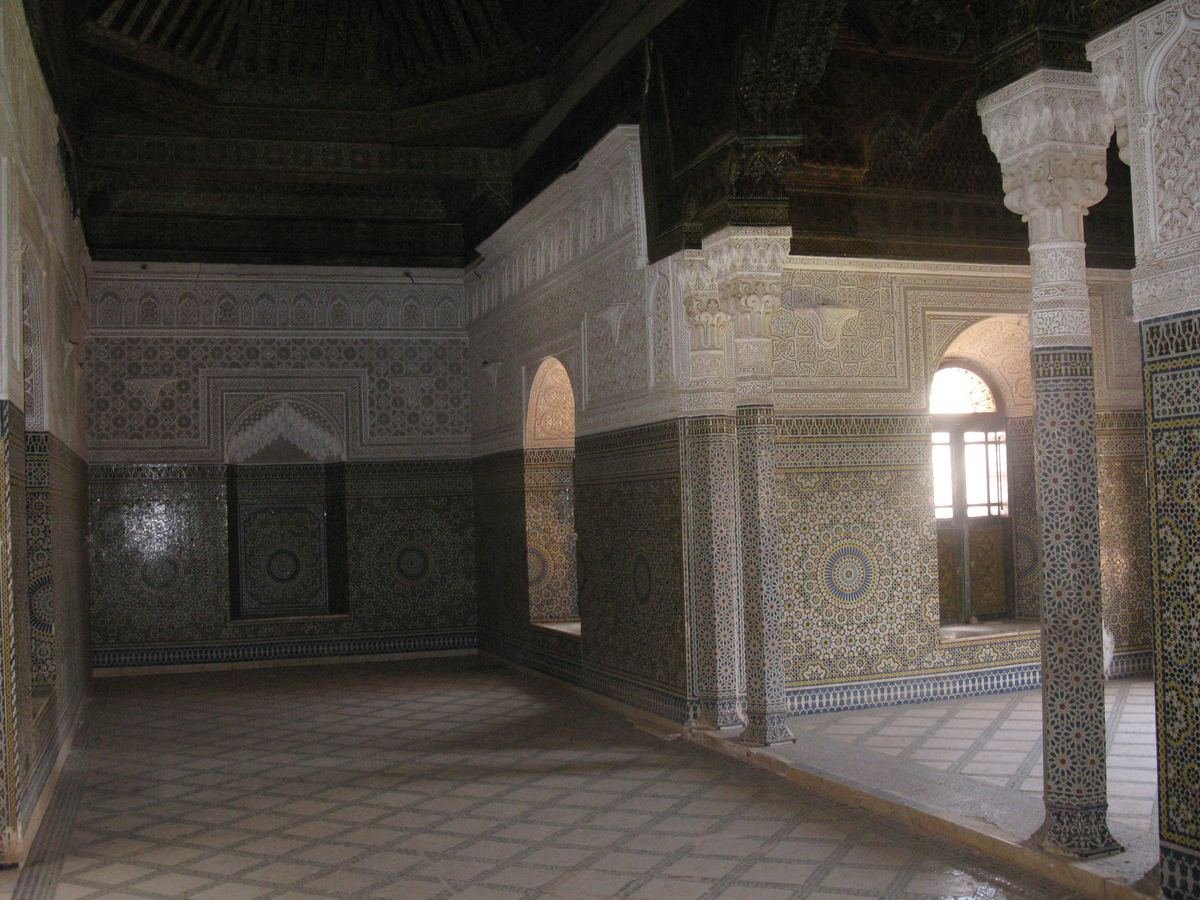
The contrast is the point of the visit. You walk through dim, plain earthen corridors and then step into rooms that look as if they belong in a Fez palace.
- The reception rooms: walls covered in zellige (cut tile mosaic) in blue, green and ochre geometric patterns, bands of finely carved plaster, and cedar ceilings painted in reds, greens and gold. Craftsmen were brought from the imperial cities to decorate them, and the style is classic Andalusi Moroccan rather than local mountain work.
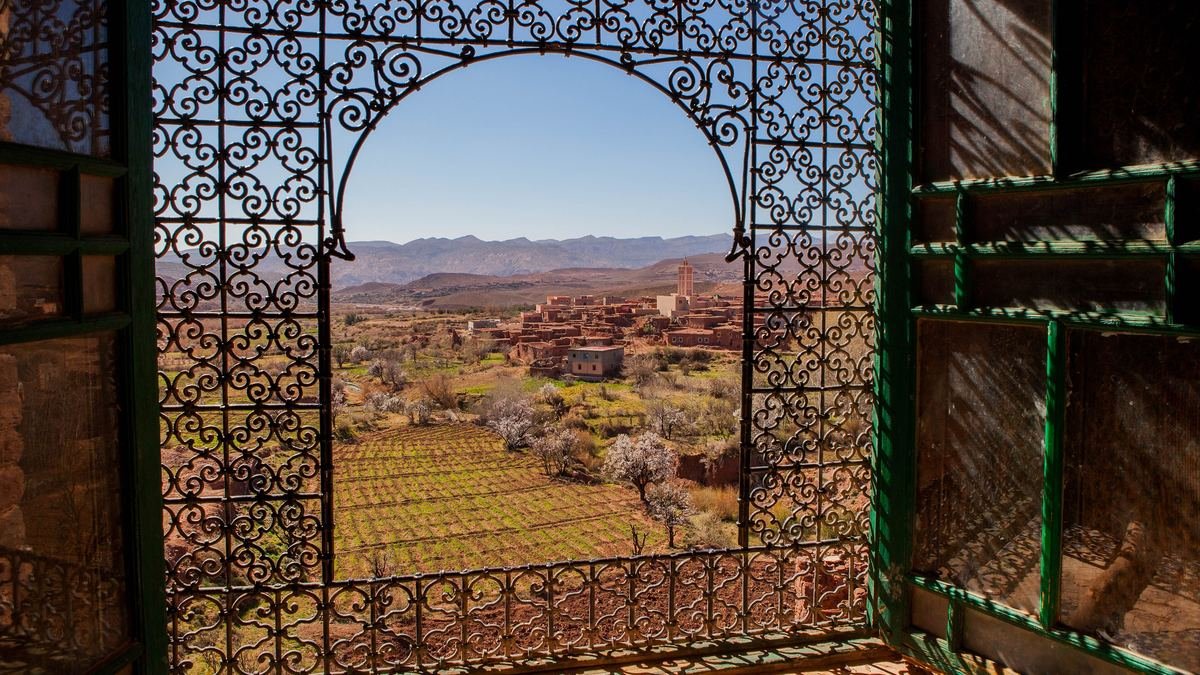
- The windows and grilles: wrought iron grilles frame views over the village, the green fields of the basin and the bare mountains around. It is the best photograph of the day.
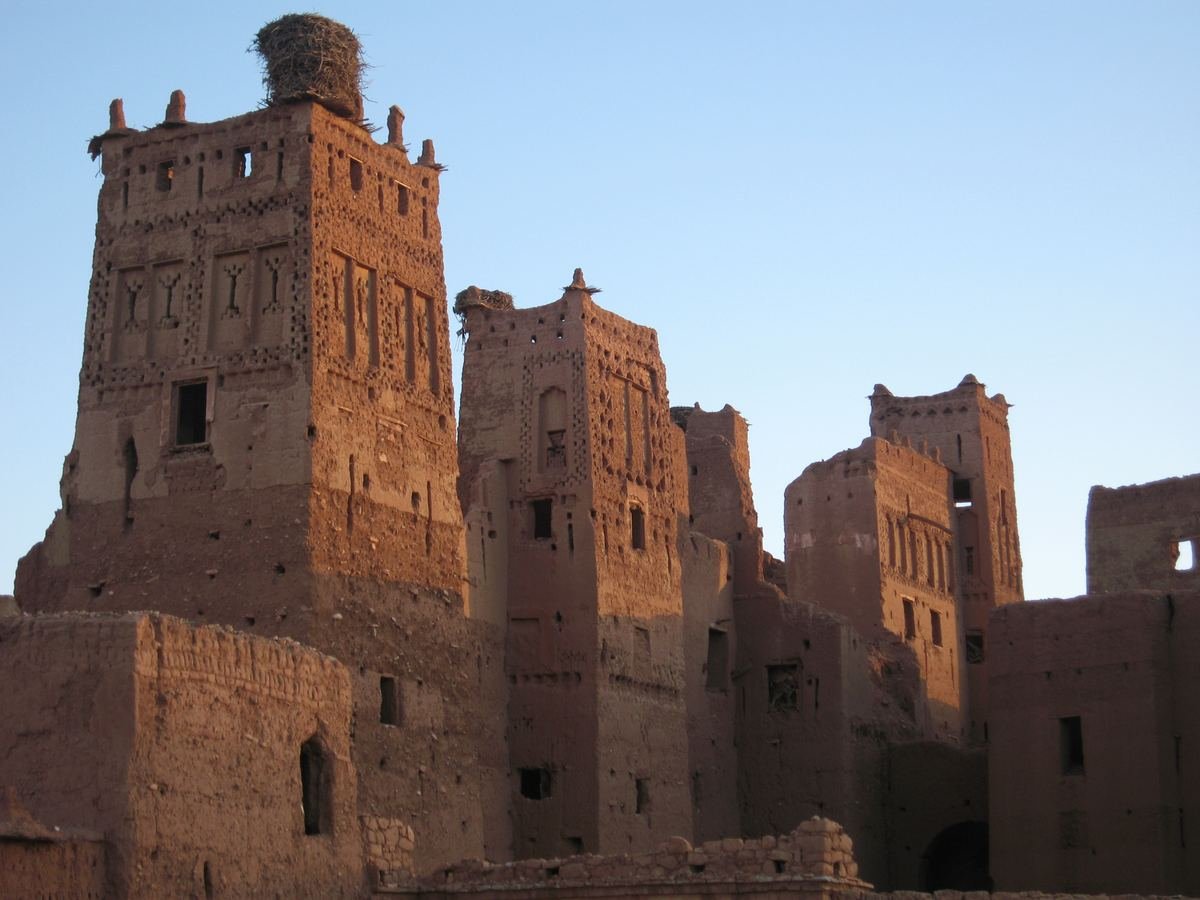
- The ruins: from the outside, the scale of the complex is clear. Towers and walls in various states of collapse spread over a wide area, some of them topped with stork nests.
- The village: Telouet is a working mountain village with small shops, cafés and a few guesthouses. A short walk around gives you a sense of life at this altitude.
Visits are guided, often in French or English, and the guide explains the history room by room. Allow about an hour inside, and longer if you want to sit with a mint tea in the village before the drive back.
The Ounila valley road, stop by stop
The road from Aït Ben Haddou to Telouet follows the Ounila river upstream for about 45 km. It was part of the old caravan route over the Atlas and lost most of its traffic when the French military built the Tizi n'Tichka road in 1936. Today it is one of the quietest scenic drives in the area. The road is paved all the way: the upper part near Telouet has been rebuilt more recently, and the lower part is older asphalt with patches and some narrow sections. Traffic is light, but watch for children, donkeys and goats on the road in villages, and for gravel on the bends.
Aït Ben Haddou
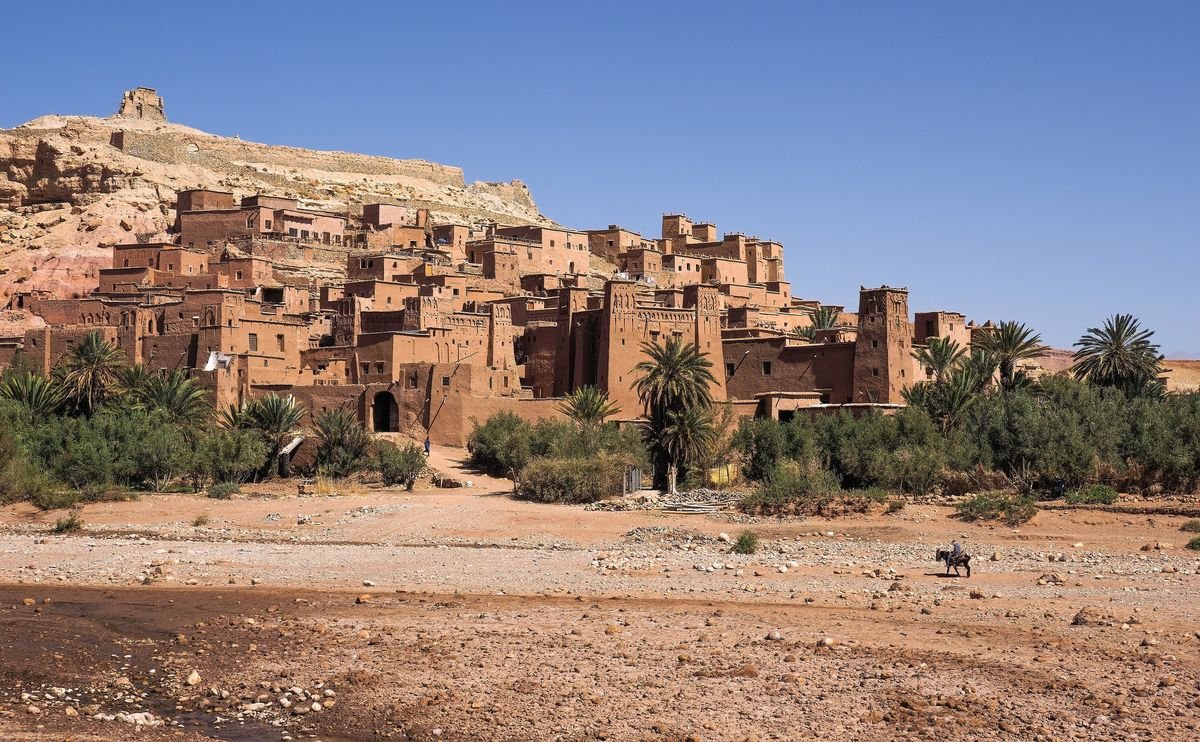
The valley starts at the UNESCO-listed ksar, about 30 km from Ouarzazate. If you have not seen it yet, the morning is the best time, before the tour groups arrive. Our Aït Ben Haddou guide covers the river crossing and the climb to the granary, so here we simply keep driving north.
Tamdaght
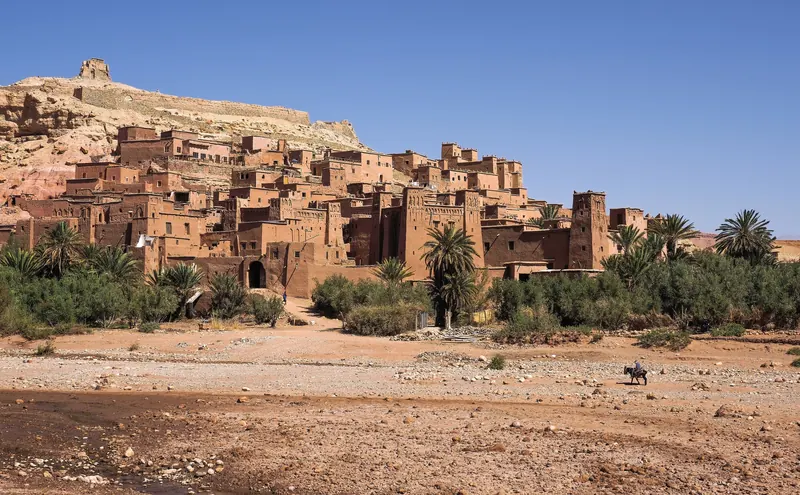
A few kilometres beyond Aït Ben Haddou, Tamdaght (also written Tamdakhte) has a Glaoui kasbah of its own, with tall decorated towers and stork nests standing above the palm trees and the river. It is largely unrestored, quieter than its famous neighbour, and worth a short stop for the walls in late afternoon light. Film crews have used the area too: a scene of Gladiator is often said to have been shot at Tamdaght, and our guide to film locations around Ouarzazate covers the wider list.
The red canyon and the villages
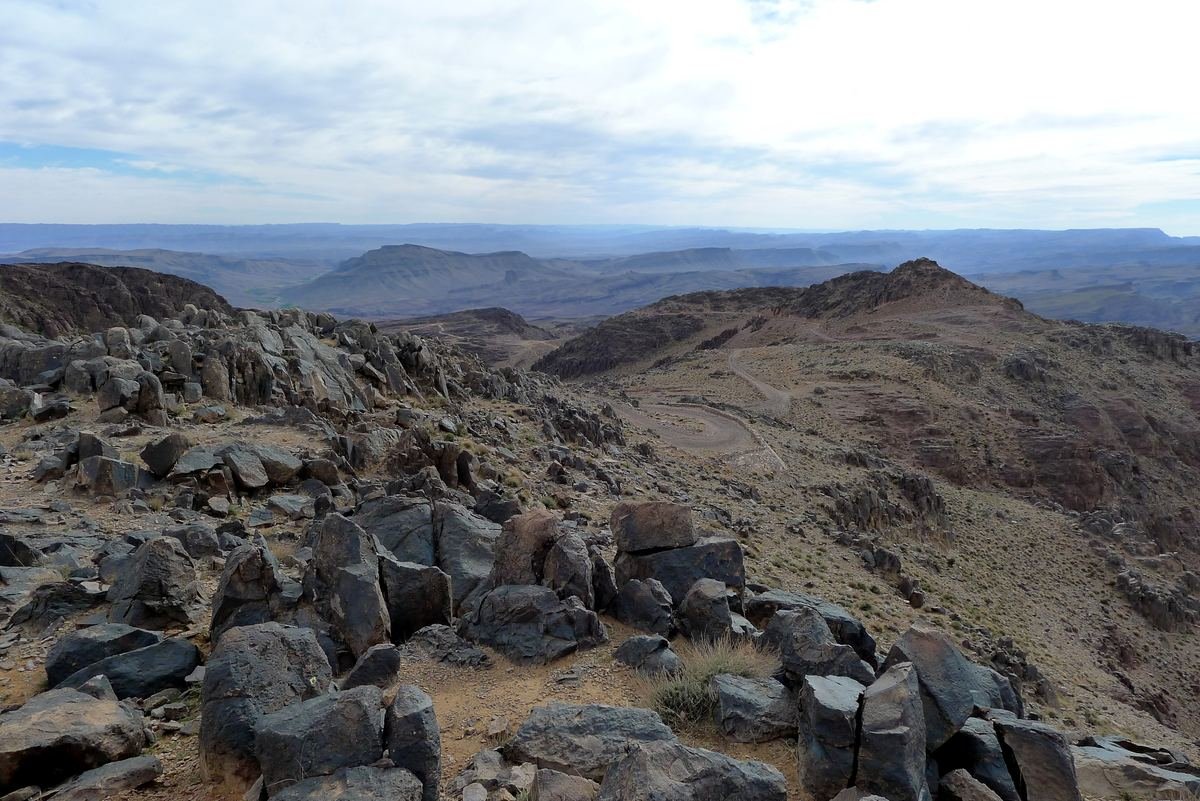
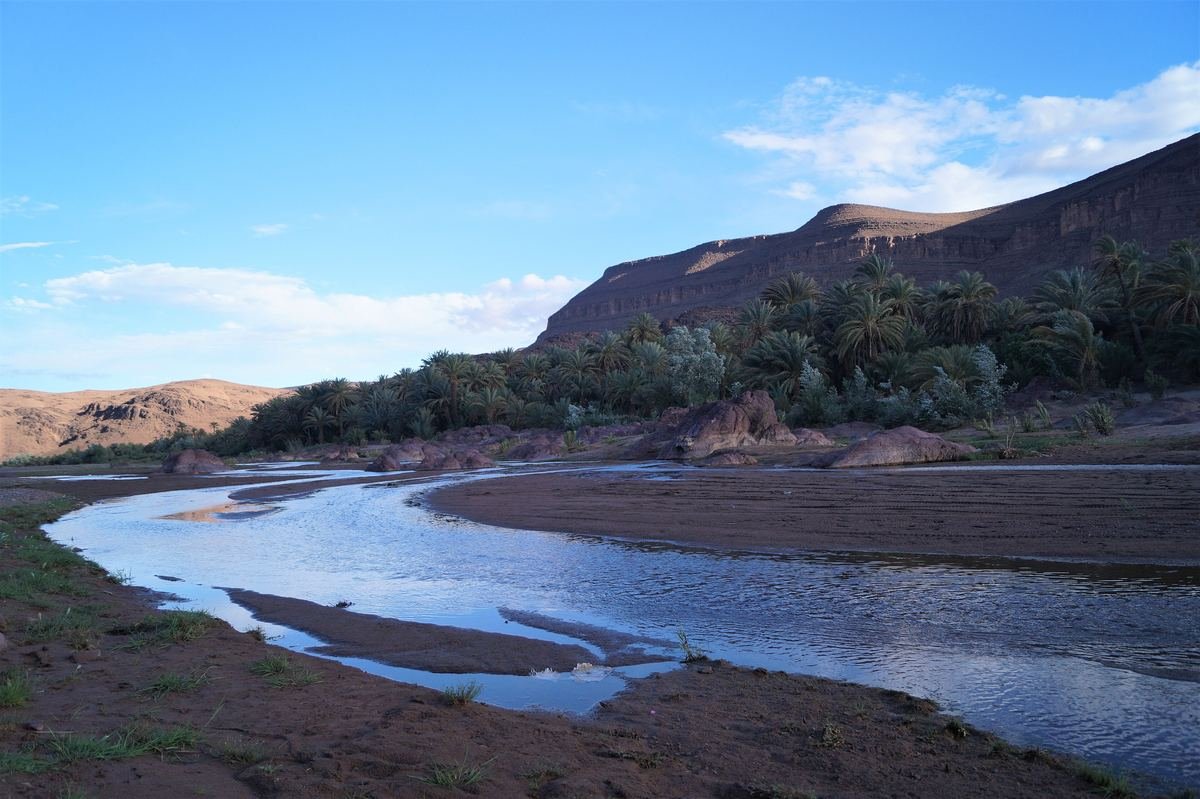
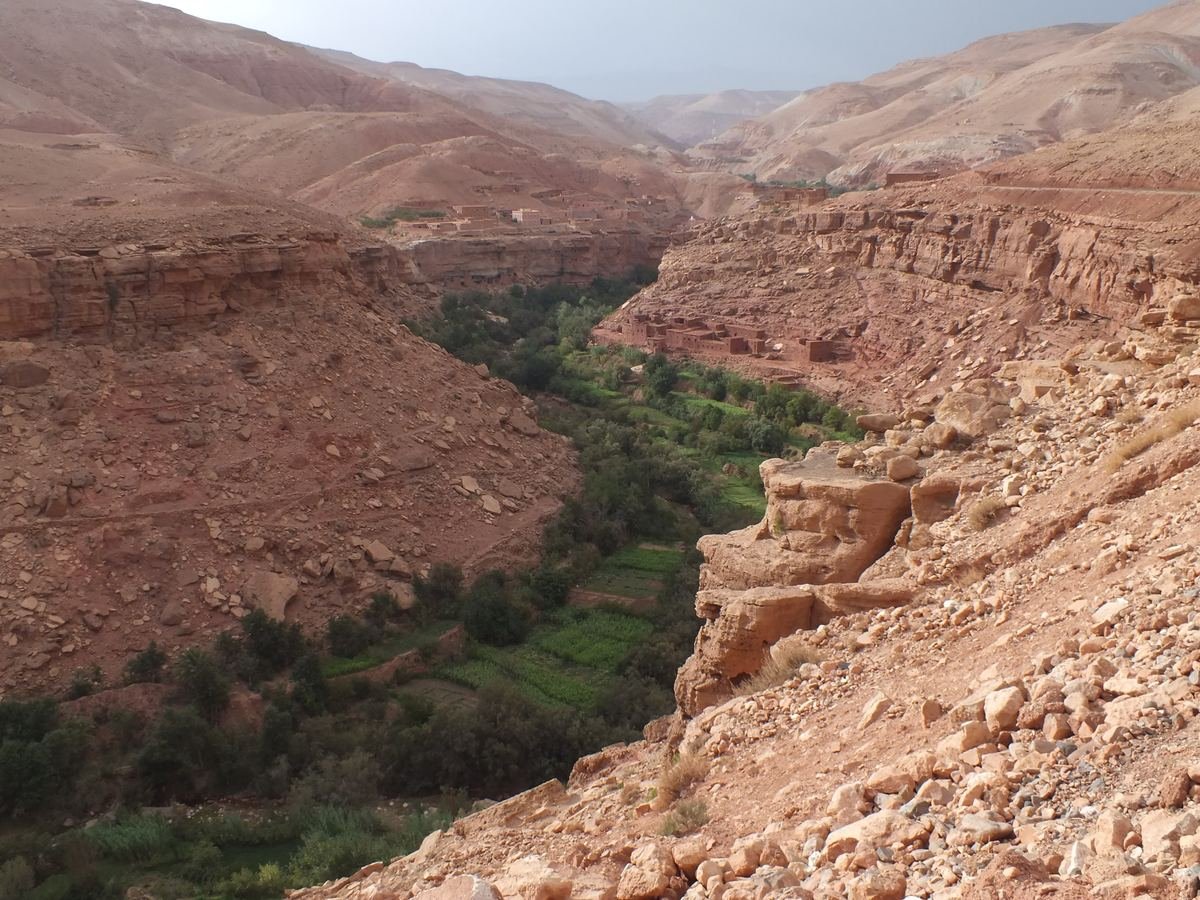
Between Tamdaght and Anemiter the valley narrows. The road climbs above a ribbon of trees, barley terraces and small orchards at the bottom of red and ochre cliffs, with earthen villages and old granaries built into the slopes. This middle section is where most people stop for photos. There are few formal viewpoints, so pull over only where the shoulder is wide enough.
Anemiter
About 12 km before Telouet, Anemiter (also spelled Anmiter) is one of the best preserved fortified villages of the valley, a dense cluster of earthen houses and towers above the fields. It is a good place to stretch your legs. If you walk into the village, keep to the paths, ask before photographing people and accept that local children may offer to guide you for a few coins.
Telouet
After Anemiter the landscape opens into a high basin with wide fields and bare hills, and the kasbah appears on the edge of the village. You can park near the entrance.
Route options from Ouarzazate
There are three practical ways to plan a Telouet day. All of them are possible in an ordinary car, and all of them are best started early.
| Option | Route | Approximate distance | Driving time without stops |
|---|---|---|---|
| Out and back by the valley | Ouarzazate, Aït Ben Haddou, Ounila valley, Telouet, same way back | about 150 km | about 4 hours |
| Loop via the N9 | Ouarzazate, Aït Ben Haddou, Ounila valley, Telouet, side road to the N9 near the Tizi n'Tichka, N9 back to Ouarzazate | about 185 km | about 4 to 4.5 hours |
| On the way to or from Marrakech | Ouarzazate, Ounila valley, Telouet, N9 over the Tizi n'Tichka to Marrakech | about 205 km | about 4.5 hours |
Which direction for the loop
We usually suggest going up the valley in the morning and coming back on the N9. You see Aït Ben Haddou in the early light, have the valley to yourself, reach Telouet around midday, and return on the faster main road in the afternoon. Going the other way works too, with the advantage of driving down the Ounila valley in the warm late light, but you then arrive at Aït Ben Haddou in the evening and drive the last 30 km back to Ouarzazate at dusk.
Combining with the Marrakech road
If you are driving between Marrakech and Ouarzazate anyway, Telouet and the Ounila valley make a slower but far more interesting alternative to staying on the N9 all the way. Our Marrakech to Ouarzazate guide covers the main road, the pass and winter conditions in detail.
Getting there: car, driver or tour
Self drive
Driving gives you the freedom to stop in the valley and to time the light. Fill the tank in Ouarzazate: fuel stations are scarce between Aït Ben Haddou and the N9. Mobile coverage is patchy in the canyon section, so download an offline map. If you need a car, our guide to car hire and driving from Ouarzazate explains what to check before you set off.
Private driver
A driver for the day is the relaxed option, especially for the loop, because the N9 descent from the Tichka side is long and full of trucks. Agree on the route, the stops (Tamdaght and Anemiter included or not), the time at Telouet and the total price before leaving. If you stay at Residence Chay, the reception can help you arrange a driver or a guide.
Organised tours
Many day tours from Marrakech pass through Telouet, but they spend most of the day on the road. From Ouarzazate, a private or small group excursion gives you much more time on site and in the valley.
Public transport
Shared grand taxis run up the valley to some villages and to Telouet, mostly in the morning, and they leave when full. It is possible, but returning the same day is not guaranteed, so it only suits travellers with time and a flexible plan.
Best time to go, weather and road conditions
Telouet is much higher than Ouarzazate, and it feels it. Expect temperatures several degrees lower, and much colder mornings in winter.
- Spring (March to May): green barley and blossom in the valley, snow often still on the higher peaks. The most attractive season.
- Autumn (September to November): clear light and comfortable temperatures, with the trees along the river turning yellow later in the season.
- Summer: pleasant at Telouet itself, but hot in the lower valley and at Aït Ben Haddou in the afternoon. Start early. Summer storms can bring short, violent floods in the riverbeds.
- Winter (December to February): bright but cold, sometimes with snow at Telouet. Snow and ice can close the Tizi n'Tichka section of the N9 for a few hours or more, so check conditions before planning the loop.
After heavy rain, ask about the state of the Ounila road before setting off: storms have damaged sections in the past. For month by month detail, see our guide to the best time to visit Ouarzazate.
Practical tips for the visit
- Entrance fee: since the reopening, visitors have reported a fee of around 50 dirhams with a guide included (observed in 2025 and 2026). Older sources quote lower prices. Check at the gate and carry small notes.
- Opening times: there are no reliable published hours. Daytime visits are the norm; do not plan to arrive late in the afternoon.
- Shoes and clothing: wear closed shoes for uneven earthen floors and steps, and bring a warm layer even in spring and autumn.
- Food: Telouet has simple cafés and guesthouse restaurants serving tagines and omelettes. Lunch in the village is part of the day, but carry water and snacks for the drive.
- Unofficial guides and touts: at the parking and in the villages you may be approached by people offering to guide you or to show you a house. Be polite and clear if you are not interested.
- Photography: interiors are dim, so a phone with a night mode or a camera that handles low light helps. Ask before photographing people.
- Walking: the valley also has walking routes between villages. If you would like a half day on foot, our guide to hiking near Ouarzazate has options and advice on finding a local guide.
Doing the Telouet loop from a base in Ouarzazate
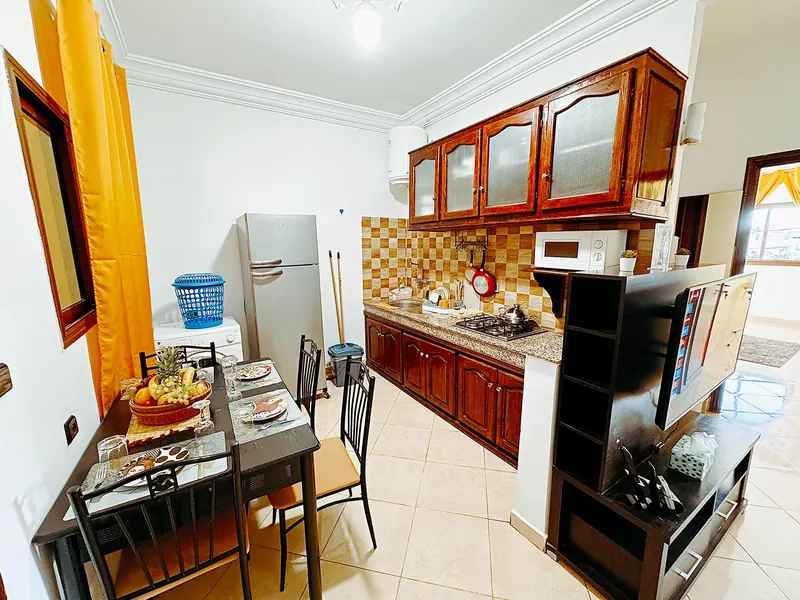
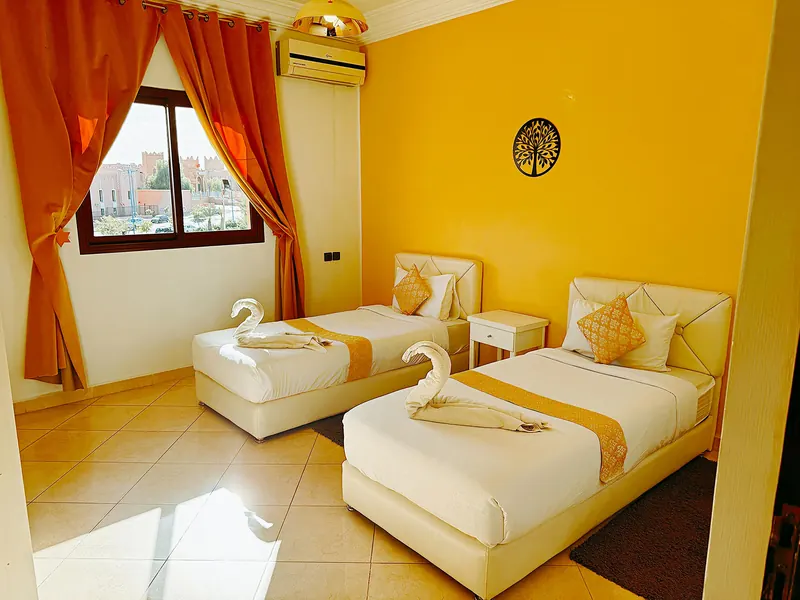
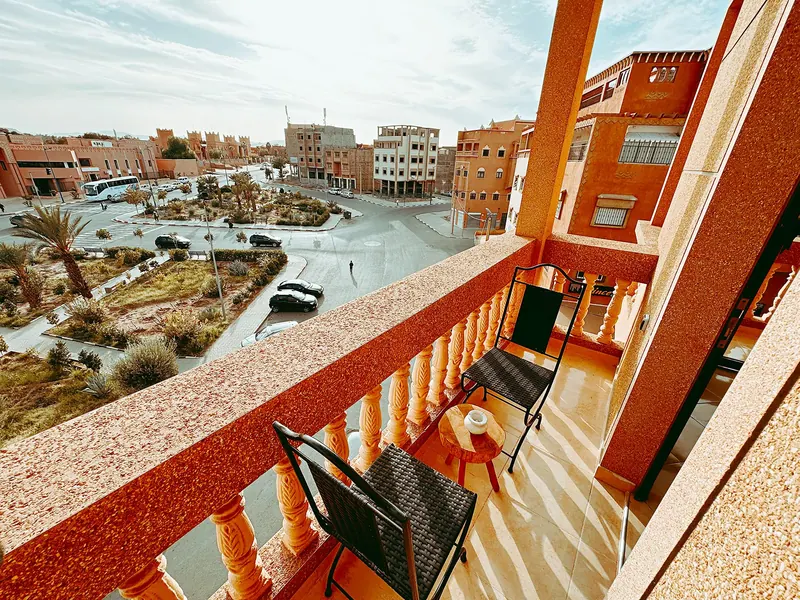
Telouet works best as a full day from Ouarzazate rather than as a rushed stop on a bus tour. Sleeping in town lets you leave at first light, see Aït Ben Haddou before the crowds, take your time in the valley, and come back to a proper dinner and a quiet night. Residence Chay is in a calm residential district about 3 minutes from the centre, with free private guarded parking and two-bedroom apartments with a full kitchen, convenient for families and small groups who want an early breakfast before a long drive.
Questions travellers ask
Is Telouet kasbah open after the 2023 earthquake?
Partly. The kasbah was closed after the earthquake of 8 September 2023 and reopened to visitors once safety work had been done, with visitors reporting it open again by 2025. Only the decorated reception rooms and a few passages can be visited; large parts of the ruin stay off limits, and the open area can change as work continues.
How long does it take to drive from Ouarzazate to Telouet?
Allow about 2 hours without stops either way: about 75 km through Aït Ben Haddou and the Ounila valley, or about 110 km on the N9 towards the Tizi n'Tichka and then the side road to Telouet. With photo stops in the valley, most people take closer to 3 hours.
Is the road from Aït Ben Haddou to Telouet paved?
Yes. The Ounila valley road, numbered P1506, is asphalt all the way and an ordinary car can drive it. The upper part near Telouet is newer; the section near Aït Ben Haddou is older asphalt with some patches. Floods can damage it after heavy storms, so ask locally if it has rained a lot.
Do you need a guide to visit Telouet kasbah?
A guide is normally included with the entrance ticket and walks you through the open rooms. Visitors since the reopening have reported a fee of around 50 dirhams with the guide included, but check the current price at the gate.
Can you visit Telouet and Aït Ben Haddou in one day?
Yes, and it is the classic way to do it. Start early from Ouarzazate, see Aït Ben Haddou in the morning light, drive up the Ounila valley to Telouet for lunch and the kasbah, then either return the same way or come back on the N9 over the Tichka side.